Cracking Your First Job Interview: A Complete Guide for Freshers
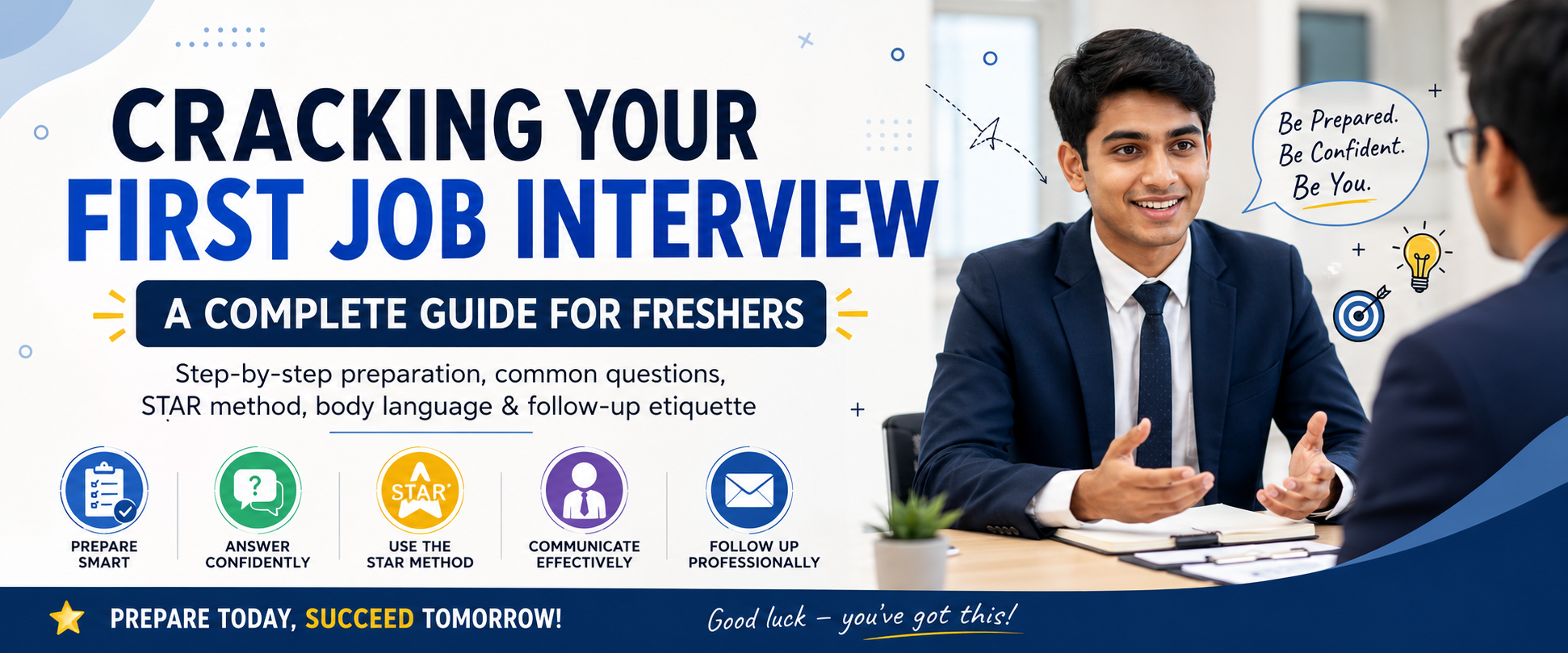
A step-by-step guide for freshers covering interview preparation, common questions, the STAR method, body language, and follow-up etiquette — everything you need to walk into your first interview with confidence.
Cracking Your First Job Interview: A Complete Guide for Freshers
Getting called for your first job interview is exciting — and nerve-wracking. You've sent out applications, polished your resume, and now there's one final step between you and your first job: the interview.
The good news? Interviewing is a skill, not a talent. It can be learned, practiced, and improved. This guide walks you through everything you need to know, from the moment you get the call to the thank-you email you send afterward.
1. Before the Interview: How to Prepare
Most interviews are lost or won in the preparation stage — long before you ever sit down in front of the interviewer.
Research the Company
Spend at least 30–45 minutes learning about the company. You should be able to answer:
- What does this company actually do? (Product, service, industry)
- Who are their main competitors?
- What's been happening with them recently? (Funding news, new launches, awards)
- What is their mission or culture like?
Where to look: the company website (especially the "About Us" and "Careers" pages), their LinkedIn page, recent news articles, and employee reviews on platforms like Glassdoor or AmbitionBox.
Understand the Job Description Inside Out
Re-read the job description and highlight every skill or requirement mentioned. For each one, think of a real example from your academic projects, internships, or college activities that proves you have it. This is the raw material for most of your answers.
Prepare Your Documents
Keep these ready, both in physical (printed) and digital form:
- Updated resume (2–3 printed copies)
- Original and photocopies of degree certificates, mark sheets, ID proof
- A list of references, if requested
- A notebook and pen to take notes during the interview
Plan Your Logistics and Outfit
- For in-person interviews: Plan your route in advance and aim to arrive 10–15 minutes early. Choose neat, formal or business-casual clothing appropriate to the company's culture.
- For virtual interviews: Test your camera, microphone, and internet connection at least an hour before. Choose a quiet, well-lit space with a clean background. Keep a glass of water nearby.
2. The Most Common Interview Questions (and How to Answer Them)
You can't predict every question, but a small set of questions show up in almost every interview. Here's how to handle them.
"Tell me about yourself."
This is usually the opening question — and it sets the tone for the rest of the interview. Avoid simply repeating your resume line by line. Instead, use a simple Present → Past → Future structure:
- Present: Who you are and what you're currently doing (e.g., recently graduated in Computer Science).
- Past: A brief highlight of relevant experience, projects, or skills.
- Future: Why you're excited about this role and what you're looking for.
Example:
"I recently completed my B.Tech in Computer Science, where I developed a strong interest in web development. During my final year, I built a full-stack project that helped students track internship applications, which taught me a lot about both coding and working under deadlines. I'm now looking to start my career as a software developer at a company where I can keep learning and contribute to real-world products — which is what drew me to this role at your company."
"Why should we hire you?"
Connect your specific skills directly to what the role needs. Don't be generic — be specific about what you bring.
Tip: Structure your answer as: Skill + Proof + Value to them.
"I have a strong foundation in Python and SQL, which I used to build a data analysis project during my internship. I'm a fast learner and enjoy solving problems — qualities that would help me quickly get up to speed and contribute to your team."
"What are your strengths and weaknesses?"
- Strengths: Pick 1–2 that are genuinely relevant to the role, and back them up with a real example.
- Weaknesses: Be honest, but choose something you're actively working to improve, and explain how. Avoid clichés like "I'm a perfectionist."
Example weakness answer:
"I used to struggle with public speaking, so I started volunteering to present my project work in college seminars. It's something I'm still working on, but I've become a lot more confident."
"Where do you see yourself in 5 years?"
Interviewers ask this to check if you're ambitious but realistic, and if your goals align with the company. Keep it focused on growth within the field, not a specific job title.
"Why do you want to work here?"
This is where your company research pays off. Mention something specific — a product, value, or recent achievement — and connect it to your own goals.
3. The STAR Method: Answering Behavioral Questions
Many interviewers ask behavioral questions like "Tell me about a time you faced a challenge" or "Describe a situation where you worked in a team." The best way to structure these answers is the STAR method:
| Letter | Meaning | What to Cover |
|---|---|---|
| S | Situation | Set the context — what was happening? |
| T | Task | What was your specific responsibility? |
| A | Action | What steps did you personally take? |
| R | Result | What was the outcome? Use numbers if possible. |
Example — "Tell me about a time you worked in a team."
Situation: "During my final semester, my team of four had to build a college event management app within three weeks." Task: "I was responsible for the backend and database design." Action: "I split the work into smaller modules, set internal deadlines, and held quick daily check-ins to track progress." Result: "We delivered the project two days early, and it was later used by the college fest committee to manage actual event registrations."
Keep your STAR answers under 2 minutes — concise but complete.
4. During the Interview: Body Language and Communication
How you say something often matters as much as what you say.
- Maintain eye contact — with the camera (not the screen) in virtual interviews.
- Sit up straight and avoid crossing your arms; it can come across as defensive.
- Smile naturally and nod to show you're engaged when the interviewer is speaking.
- Avoid filler words like "um," "like," and "basically." Pausing briefly before answering is far better than filling silence with filler words.
- Match your tone to the question — confident for skill-based questions, thoughtful for reflective ones.
- Listen fully before answering. Don't interrupt, and if you don't understand a question, it's perfectly fine to ask for clarification.
5. Questions You Should Ask the Interviewer
Almost every interview ends with: "Do you have any questions for us?" Always say yes — asking thoughtful questions shows genuine interest. A few strong examples:
- "What does a typical day look like for someone in this role?"
- "What does success look like in this position in the first six months?"
- "How would you describe the team culture here?"
- "What are the next steps in the interview process?"
Avoid asking about salary or leave policy too early — save those for the HR round, unless they bring it up first.
6. Common Mistakes Freshers Make
- Being underprepared on the company — not knowing what they do is one of the fastest ways to lose credibility.
- Speaking negatively about previous colleges, professors, or internships.
- Giving one-word or overly long, unfocused answers. Aim for a balance — clear and complete, but not rambling.
- Not having any questions to ask at the end.
- Lying or exaggerating skills on the resume — interviewers often dig deeper into exactly what you claim to know.
- Arriving late or joining a virtual call last-minute without testing the setup beforehand.
7. After the Interview: Follow-Up Etiquette
The interview isn't quite over once you leave the room.
- Send a thank-you email within 24 hours, thanking the interviewer for their time and briefly reiterating your interest in the role.
- Keep it short — 3–4 sentences is enough.
- If you don't hear back within the timeline they mentioned, it's okay to send one polite follow-up email asking about the status of your application.
Sample thank-you email:
Subject: Thank You – [Your Name], [Position] Interview
Hi [Interviewer's Name],
Thank you for taking the time to speak with me today about the [Position] role. I really enjoyed learning more about the team and the work you're doing on [something specific they mentioned]. I'm excited about the opportunity and look forward to hearing about the next steps.
Best regards, [Your Name]
8. Quick Pre-Interview Checklist
- Researched the company and role thoroughly
- Prepared answers for common questions using the STAR method
- Printed/organized all required documents
- Tested tech setup (for virtual interviews) or planned travel route (for in-person)
- Picked out appropriate outfit
- Prepared 2–3 thoughtful questions to ask the interviewer
- Got a good night's sleep before the big day
Final Thoughts
Your first interview doesn't need to be perfect — it needs to be honest, prepared, and confident. Every interview, even the ones that don't go your way, teaches you something for the next one. Walk in prepared, be yourself, and remember: the company isn't just evaluating you — you're also evaluating whether this is the right place for you to grow.
Good luck — you've got this!